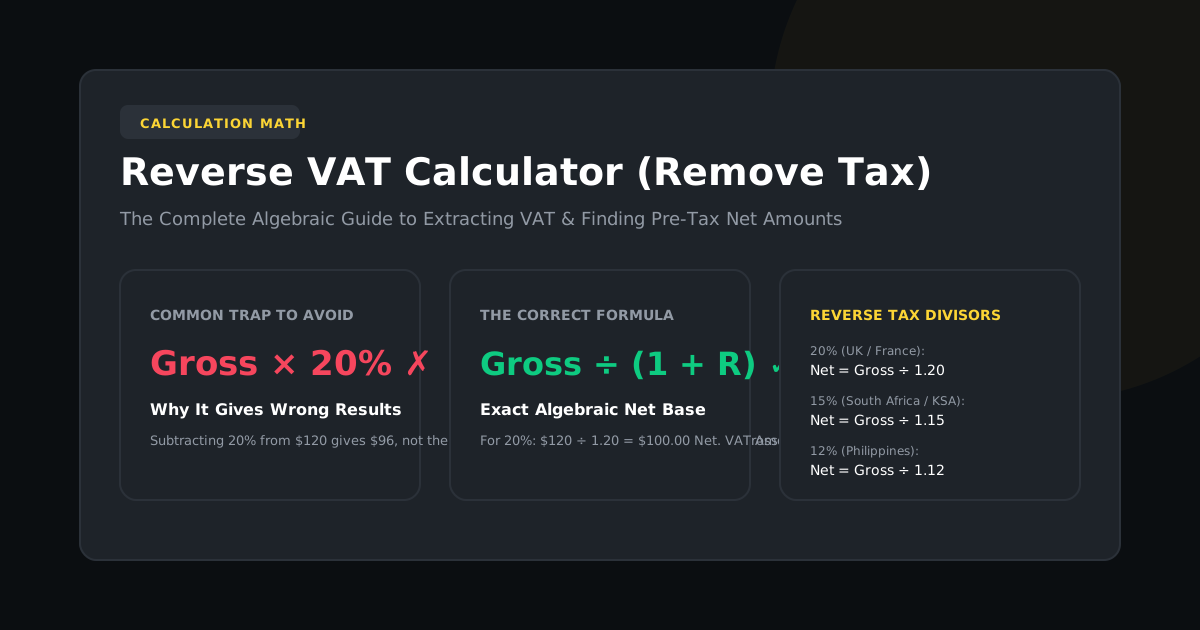
One of the most persistent accounting mistakes in bookkeeping and retail auditing is attempting to remove VAT by subtracting the tax percentage directly from the final gross price. In financial mathematics, reversing sales tax requires understanding base asymmetry.
Whether extracting 20% from UK VAT receipts, backing out 19% German MwSt, or auditing 15% invoices under South African SARS rules, this guide reveals the exact algebraic equations and provides ready-to-use divisor tables. You can also toggle our interactive calculator to "Remove VAT" mode for instant, error-free results.
The Mathematical Percentage Trap Explained
Consider an item with a pre-tax net cost of $100.00. When 20% VAT is added:
$100.00 Net + ($100.00 × 0.20) = $120.00 Gross Total
If someone gives you that $120.00 receipt and you attempt to remove 20% by simply taking 20% of $120.00:
$120.00 × 0.20 = $24.00 → $120.00 - $24.00 = $96.00 (INCORRECT!)
You have arrived at $96.00 instead of the true $100.00 net base! Why? Because 20% of 120 is larger than 20% of 100. The denominator has changed.
The Universal Reverse VAT Formula
If you need to quote forward prices instead of stripping tax, consult our Add VAT Net-to-Gross Guide. To reverse tax correctly, we set up the basic algebraic relationship where R is the tax rate as a decimal (e.g., 0.20):
• VAT Amount = Gross Total - Net Base
• Direct Tax Formula = Gross × (R ÷ (1 + R))
Statutory Reverse VAT Divisor Cheat Sheet
Use these verified mathematical multipliers and divisors for leading global tax jurisdictions:
| Jurisdiction & Tax Rate | Net Divisor Formula | Direct Tax Multiplier | $100 Gross Example |
|---|---|---|---|
| 20% VAT (UK, France) | Gross ÷ 1.20 | Gross × (1 ÷ 6) [0.1667] | Net: $83.33 | VAT: $16.67 |
| 19% MwSt (Germany) | Gross ÷ 1.19 | Gross × (19 ÷ 119) [0.1597] | Net: $84.03 | VAT: $15.97 |
| 15% VAT (South Africa, KSA) | Gross ÷ 1.15 | Gross × (15 ÷ 115) [0.1304] | Net: $86.96 | VAT: $13.04 |
| 13% VAT (Nepal) | Gross ÷ 1.13 | Gross × (13 ÷ 113) [0.1150] | Net: $88.50 | VAT: $11.50 |
| 12% VAT (Philippines) | Gross ÷ 1.12 | Gross × (12 ÷ 112) [0.1071] | Net: $89.29 | VAT: $10.71 |
| 5% VAT (UAE) | Gross ÷ 1.05 | Gross × (5 ÷ 105) [0.0476] | Net: $95.24 | VAT: $4.76 |
Step-by-Step Accounting Reversal Example
Suppose your business purchases specialized engineering tools in London with an invoice total of £1,440.00 Gross.
- Identify the rate: UK standard VAT is 20% (0.20).
- Determine the divisor: 1 + 0.20 = 1.20.
- Calculate net pre-tax expense: £1,440.00 ÷ 1.20 = £1,200.00.
- Determine reclaimable input tax: £1,440.00 - £1,200.00 = £240.00.
- Alternative check: £1,440.00 ÷ 6 = £240.00 (Verification matches).