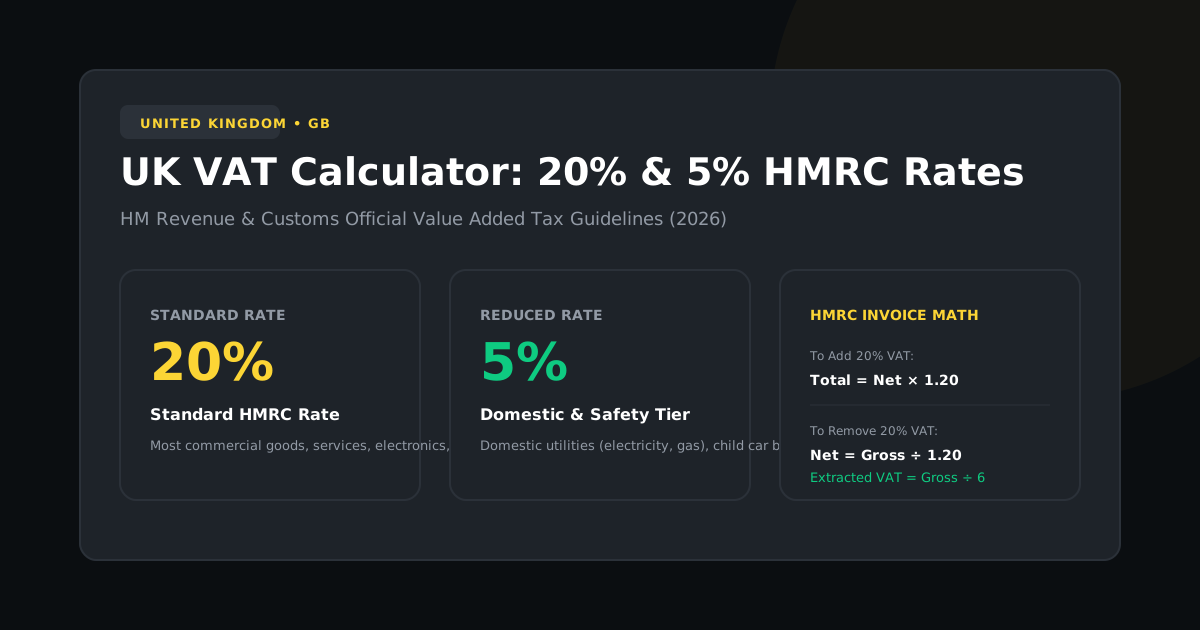
Value Added Tax (VAT) in the United Kingdom is administered by HM Revenue and Customs (HMRC). While the primary 20% standard rate applies across the vast majority of goods and professional services, UK commerce also features a 5% reduced rate and extensive zero-rated (0%) categories.
Whether you are a VAT-registered sole trader reconciling monthly accounts, a business issuing commercial invoices, or a buyer verifying VAT on a purchase receipt, this guide explains exact formulas, HMRC compliance rules, and how to use our free online VAT calculator.
Current UK VAT Rates Schedule
HMRC categorizes supplies into three distinct tax bands:
| Classification | Rate | Common Eligible Goods & Services |
|---|---|---|
| Standard Rate | 20.0% | Electronics, legal and accountancy services, motor vehicles, standard retail, confectionary, alcoholic beverages. |
| Reduced Rate | 5.0% | Domestic fuel and power, children's car seats, mobility aids for the elderly, smoking cessation products. |
| Zero Rate | 0.0% | Most staple supermarket food, children's footwear and clothing, physical books, newspapers, sanitary products. |
| Exempt | Exempt | Financial investments, postage stamps, health and medical treatments provided by registered practitioners. |
How to Calculate 20% UK VAT
Let's review the exact arithmetic for both adding and taking off 20% VAT.
1. Adding 20% VAT to a Net Price
To quote a client inclusive of VAT or calculate final customer pricing from net cost:
• 20% VAT: £850.00 × 0.20 = £170.00
• Gross Total Due: £850.00 + £170.00 = £1,020.00
2. Removing 20% VAT from a Gross Price (The 1/6th Rule)
When you have a gross receipt of £120.00, subtracting 20% of £120.00 gives £96.00, which is incorrect. If your business trades across the Irish border, also review our Ireland 23% VAT Guide. In mathematics, VAT was added on top of the original net base (100% + 20% = 120%). For a full algebraic proof, explore our Reverse VAT Calculation Guide. Therefore, to extract the original net base:
• Net Subtotal: £240.00 ÷ 1.20 = £200.00
• Reclaimable VAT: £240.00 ÷ 6 = £40.00 (or £240.00 - £200.00)
UK VAT Registration Thresholds (2024–2026)
Under HMRC regulations, a business must register for VAT if:
- Your total VAT taxable turnover exceeds £90,000 in any rolling 12-month period (increased from £85,000 in April 2024).
- You expect your taxable turnover to exceed £90,000 in the next 30 days alone.
Once registered, businesses are legally obligated to charge VAT, issue valid VAT invoices, and submit digital tax returns under HMRC's Making Tax Digital (MTD) framework every quarter.
Domestic Reverse Charge for Construction
In the UK construction sector, the VAT domestic reverse charge prevents missing-trader fraud. If you provide construction services covered by the Construction Industry Scheme (CIS) to another VAT-registered contractor, you do not charge VAT on the invoice. Instead, the recipient contractor accounts for the 20% VAT directly on their own VAT return.