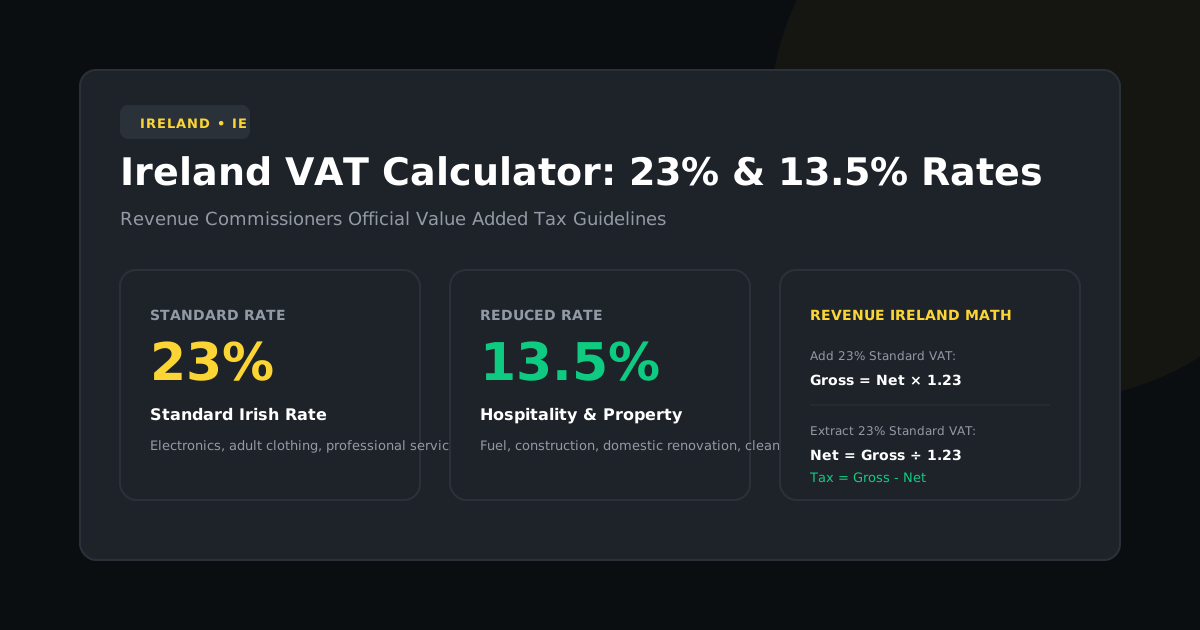
Navigating Irish indirect taxation requires balancing the 23% standard rate with multiple reduced bands (13.5% and 9%), governed by the Value-Added Tax Consolidation Act 2010 under the supervision of the Office of the Revenue Commissioners.
Whether invoicing Dublin technology firms, managing cross-border trade with Northern Ireland (see our UK VAT Guide), charging tourism services, or calculating import duties, this guide provides exact mathematical equations, threshold guidelines, and tips for our interactive VAT calculation engine.
Irish Statutory VAT Rate Structure
Ireland employs one of Europe's most multi-tiered indirect tax frameworks:
| Tier | Rate | Applied Supplies |
|---|---|---|
| Standard Rate | 23.0% | Commercial goods, electronics, motor vehicles, legal and professional services, adult apparel, alcohol. |
| Reduced Rate | 13.5% | Building and construction services, heating fuel, electricity, domestic cleaning, routine repair services. |
| Second Reduced Rate | 9.0% | Periodicals, newspapers, electronic news publications, certain sporting facilities. |
| Livestock Rate | 4.8% | Live cattle, sheep, horses, goats, and agricultural stock. |
| Zero Rate | 0.0% | Oral medicines, infant food and clothing, books, intra-EU B2B dispatches. |
How to Calculate Irish VAT: Formulas & Examples
1. Adding 23% Standard VAT
To invoice a commercial client in Ireland:
• VAT at 23%: €1,200.00 × 0.23 = €276.00
• Total Invoice: €1,200.00 + €276.00 = €1,476.00
2. Extracting 23% Standard VAT
To separate VAT from a consumer gross receipt using reverse VAT extraction:
• Net Value: €615.00 ÷ 1.23 = €500.00
• Reclaimable VAT: €615.00 - €500.00 = €115.00
3. Adding the 13.5% Reduced Rate
For building contractors and electrical service providers:
Registration & Revenue Online Service (ROS)
In Ireland, compulsory VAT registration triggers when taxable turnover exceeds:
- €80,000 for persons supplying taxable goods.
- €40,000 for persons supplying taxable services.
Registered traders file the standard VAT3 return bi-monthly through ROS (Revenue Online Service), declaring output VAT (T1) and deductible input VAT (T2).