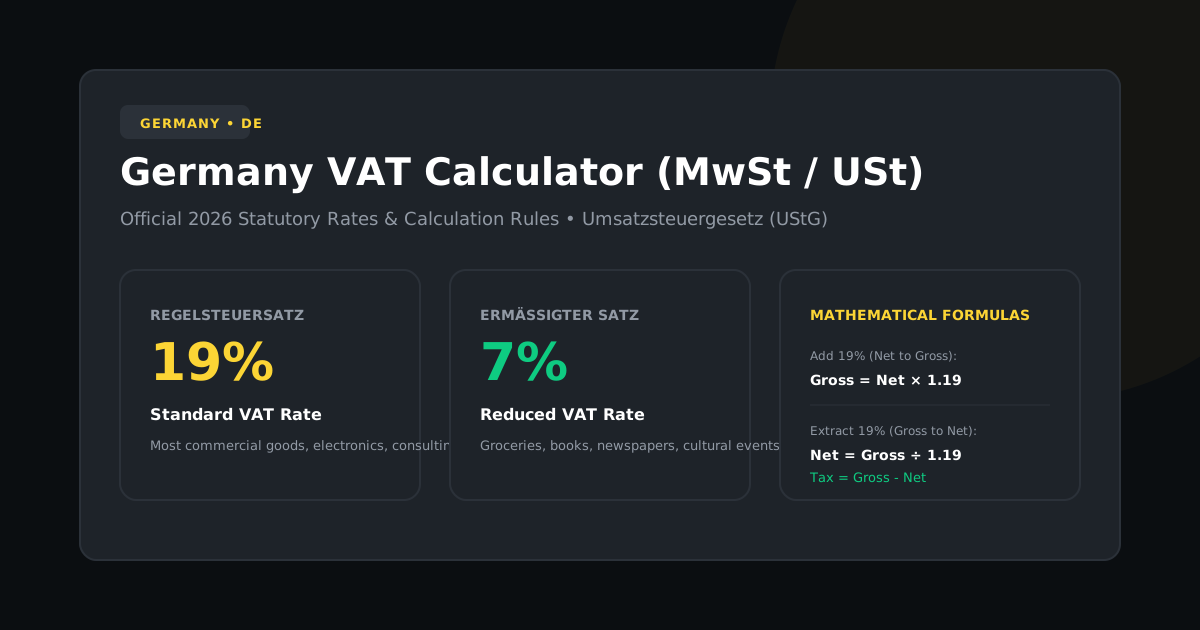
Whether you operate an e-commerce storefront selling to German consumers or manage corporate invoicing under the Umsatzsteuergesetz (UStG), calculating Value Added Tax in Germany requires an exact understanding of the 19% standard rate (Regelsteuersatz) and the 7% reduced rate (ermäßigter Steuersatz).
In Germany, Value Added Tax is known interchangeably as Mehrwertsteuer (MwSt) in consumer transactions and Umsatzsteuer (USt) in official B2B tax filings with the Finanzamt. Our real-time online VAT calculator allows you to toggle effortlessly between adding MwSt to a net figure or extracting tax from a gross invoice total.
Current Statutory VAT Rates in Germany
German tax legislation establishes two primary tax tiers, accompanied by zero-rated cross-border export provisions:
| Tax Category | Statutory Rate | German Term | Applicable Goods & Services |
|---|---|---|---|
| Standard Rate | 19.0% | Regelsteuersatz | Electronics, motor vehicles, software licenses, consulting, hotel restaurant meals, retail goods. |
| Reduced Rate | 7.0% | Ermäßigter Satz | Basic grocery staples, printed & digital books, public rail transport, newspapers, cultural admissions. |
| Zero-Rated / Exempt | 0.0% | Steuerfrei | Intra-Community B2B EU supplies (reverse charge), international freight, financial & medical services. |
How to Calculate German MwSt: Formulas & Examples
Calculating German tax accurately depends on whether your starting figure is net (exclusive of tax) or gross (inclusive of tax).
1. Adding 19% VAT (Net to Gross)
When drafting a proposal or quoting B2B clients in Germany, quotes are typically presented net. To calculate the final payable invoice total:
• MwSt (19%): €1,500.00 × 0.19 = €285.00
• Gross Total: €1,500.00 + €285.00 = €1,785.00
2. Removing 19% VAT (Gross to Net / Reverse VAT)
When auditing retail receipts or processing business expense reports where only the final gross total is displayed, never subtract 19% directly from the gross total. Subtracting 19% from gross is a common mathematical error that artificially shrinks your tax recovery (learn the exact algebra in our Reverse VAT Guide).
• Net Amount: €595.00 ÷ 1.19 = €500.00
• Extracted MwSt (19%): €595.00 - €500.00 = €95.00
Pro-Tip for Cross-Border EU Traders:
Under the EU One-Stop Shop (OSS) rules (detailed in our 2026 Global Rates Guide), cross-border B2C distance sales exceeding the annual EU-wide €10,000 threshold require charging German MwSt (19% or 7%) to German resident consumers, regardless of where your business is based within the European Union.
Input Tax Deduction (Vorsteuerabzug) in Germany
Registered German businesses act as tax collectors for the Finanzamt. When filing your monthly or quarterly VAT advance return (Umsatzsteuer-Voranmeldung), you deduct the input tax (Vorsteuer) you paid on business purchases from the output tax (Umsatzsteuer) you collected from customers.
To maintain eligibility for input tax deductions under § 15 UStG, ensure your incoming vendor invoices contain all mandatory statutory details:
- Full legal name and address of supplier and recipient
- Tax number (Steuernummer) or VAT identification number (USt-IdNr.)
- Date of issue and continuous invoice number
- Quantity and commercial description of the delivered goods or services
- Net amount broken down by tax rate (19% vs 7%) and exact tax sum
German Small Business Exemption (Kleinunternehmerregelung)
Under § 19 UStG, micro-entrepreneurs and freelancers can opt out of charging MwSt if their prior calendar year turnover did not exceed €22,000 and current year turnover is not expected to exceed €50,000.
While small business status reduces administrative overhead, you cannot reclaim input tax paid on operating expenses or capital assets. In addition, qualifying invoices must include the statutory note: "Gemäß § 19 UStG wird keine Umsatzsteuer berechnet."